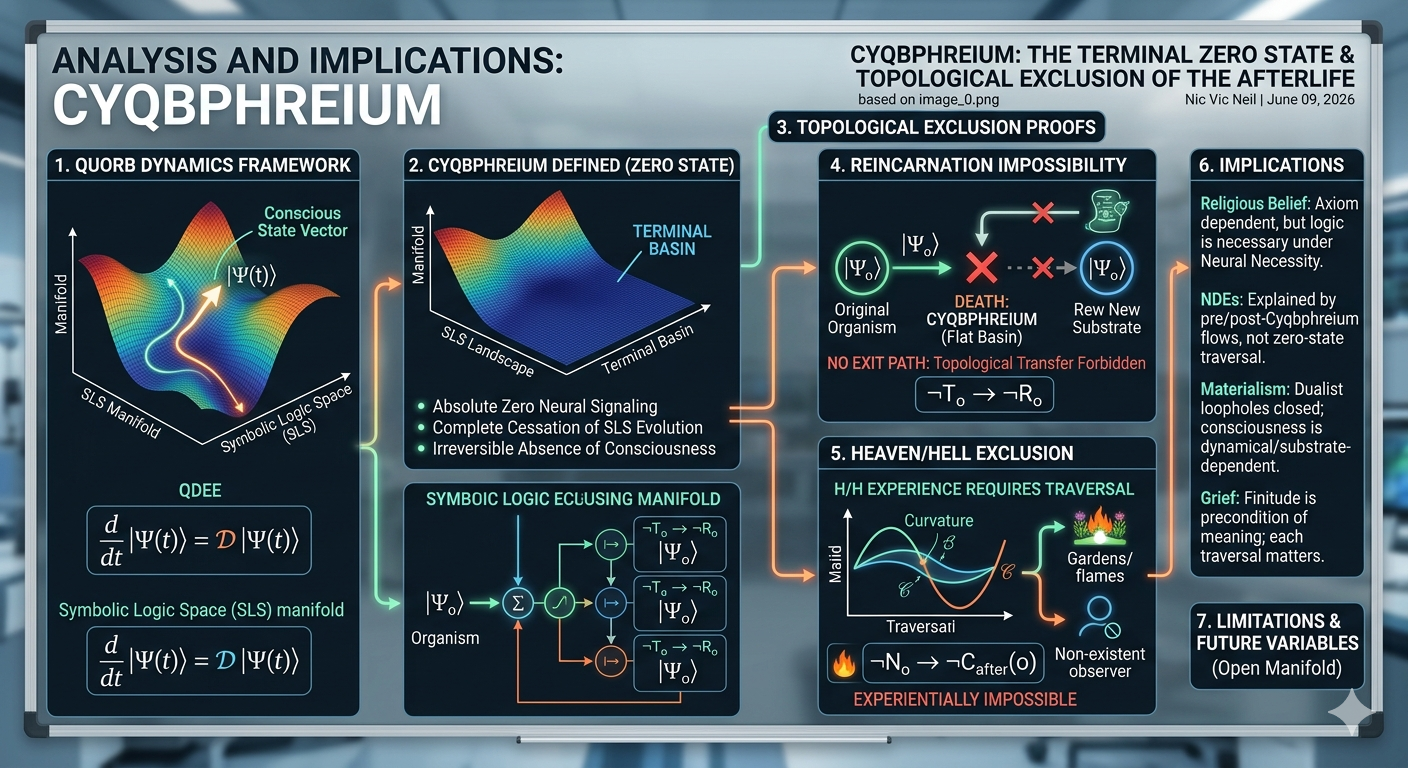
QUORB DYNAMICS
Proof of Concept: Applied to Consciousness, Death, and Afterlife
Cyqbphreium
The Zero State and the Topological Exclusion of
Reincarnation, Heaven, and Hell
Nic Vic Neil
June 2026
Preface: This Essay as Proof of Concept
Quorb Dynamics is a general framework for modeling consciousness, cognition, and symbolic reasoning as topological evolution in a curved manifold. This essay is a proof of concept — demonstrating the framework's precision on a bounded, well-defined problem domain. The domain was chosen precisely because it exposes the gap between verbal philosophical argument and topological proof.
Quorb Dynamics was not constructed to reach the conclusions in this essay. The conclusions follow from what the framework independently reveals about terminal states in the Symbolic Logic Space (SLS). The relationship is analogous to calculus and Newtonian mechanics: the instrument makes precise what verbal reasoning could only assert. Cyqbphreium — the Zero State — is not a premise engineered to support the argument. It is a natural consequence of what happens when the QDEE's driving operator is eliminated.
The problem domain of death and afterlife is ideal for a proof-of-concept demonstration for three reasons:
This essay therefore makes two claims simultaneously: a philosophical claim about consciousness and death, and a methodological claim about what Quorb Dynamics can do. The second claim is the more important one.
Abstract
This essay introduces Cyqbphreium — the terminal Zero State in the Quorb Dynamics framework — defined as the complete cessation of evolution in the Symbolic Logic Space (SLS), corresponding to absolute zero neural signaling and the irreversible absence of consciousness.
Quorb Dynamics models consciousness as a state vector |Ψ(t)⟩ evolving in a curved SLS manifold under the Quorb Dynamics Evolution Equation (QDEE): d/dt |Ψ(t)⟩ = 𝒟 |Ψ(t)⟩. The operator 𝒟 encodes flows, gradients, symbol bindings (ℬ), curvature (𝒞), and constraints. Consciousness is active traversal. Emotion is local curvature. Decision is basin collapse. Death is the elimination of 𝒟 itself.
Using SLS reachability analysis, Quorb Symbolic Calculus (QSC) operations, and basin collapse mechanics, this essay proves that reincarnation, heaven, and hell are topologically impossible: no state vector |Ψ⟩ can persist, transfer, or reconstitute beyond Cyqbphreium under the presented axioms. The argument claims logical necessity within those axioms — not absolute metaphysical certainty. New provable variables remain possible and are formally catalogued. Until such evidence appears, the Zero State closes survivalist afterlife models.
1. Introduction: From Verbal Argument to Topological Proof
The question of what happens after death has been addressed by philosophy and religion for millennia. These traditions share a structural assumption: consciousness is a substance or essence capable of migrating across substrates — through reincarnation, divine judgment, or continued soul-existence in heaven or hell.
Neuroscience proposes a competing model: consciousness is not a substance but a process — an emergent property of neural dynamics. When the dynamics cease, the process ceases. No substrate carries it forward.
This competing model has been argued verbally many times. What it has lacked is formal precision. Verbal arguments against survivalism typically assert: "there is no substrate to carry the soul." This is correct but structurally incomplete. It asserts impossibility without specifying why transfer is structurally forbidden — what topological property of the post-death state makes it unreachable from any survivalist continuation.
Quorb Dynamics supplies that precision. By modeling consciousness as a state vector navigating a curved SLS manifold under the QDEE, the framework converts verbal impossibility claims into topological reachability proofs. The question becomes: given the geometry of the Zero State, does an exit path exist? The answer is demonstrably no — and "demonstrably" here means formally, not rhetorically.
1.1 The Core Equation
The Quorb Dynamics Evolution Equation (QDEE) governs all consciousness dynamics within the framework:
d/dt |Ψ(t)⟩ = 𝒟 |Ψ(t)⟩
Where: |Ψ(t)⟩ is the Quorb state vector — the current cognitive/conscious configuration as a superposition of potentials, bindings, and intentions. t is an abstract evolution parameter (cognitive epochs, neural processing cycles, deliberation steps — not necessarily physical time). 𝒟 is the Quorb Dynamics Operator — encoding flows, gradients, symbol bindings, curvature, and constraints driven by neural activity.
This equation is analogous to the Schrödinger equation in quantum mechanics or flow equations in dynamical systems — but designed specifically for symbolic, meaning-laden processes. It is a representational model of consciousness dynamics, not a physical theory. Its precision comes from the topology it imposes on the problem, not from claims about underlying physics.
1.2 Key Components of Quorb Dynamics
Symbolic Logic Space (SLS): A curved, multi-layered manifold where cognitive states exist as points or regions. Basins are attractors representing stable meanings, decisions, and beliefs. Ridges and saddles are points of tension or choice. Diffuse potential regions are pre-symbolic, high-entropy states. Forbidden regions are topologically unreachable or unstable areas.
Quorb Symbolic Calculus (QSC): Operators for manipulating the state vector: ∂_s (directional symbolic differential — probes or shifts along a meaning dimension), ℬ(A,B) (symbolic binding — fuses two concepts, reshaping topology), 𝒞(Ψ)(curvature operator — detects and amplifies tension, experienced phenomenologically as emotion or focus).
Dynamics Mapping:
2. Cyqbphreium: The Terminal Basin
2.1 Formal Definition
Cyqbphreium is the Zero State in SLS: a diffuse-to-flat potential basin where entropy ℇ → 0, all gradients vanish, and no further QDEE evolution occurs. Formally: d/dt |Ψ⟩ = 0, 𝒞(Ψ) = 0, ∂_s = 0 for all s, and no ℬ operations are possible.
Cyqbphreium is distinguished from superficially similar states:
2.2 The Landscape Analogy
Imagine SLS as a living topological landscape of basins and ridges. A conscious mind actively traverses this landscape — flowing along gradients, binding symbols (ℬ), spiking curvature during emotional tension (𝒞), collapsing into decisions. A sleeping mind is a low-gradient landscape. An anesthetized mind is a temporarily flattened landscape that retains underlying topology. Cyqbphreium is the elimination of the landscape itself: no ridges, no flows, no motion possible.
The critical distinction: unconsciousness retains potential for reactivation — shallow basins exist and gradients can be re-introduced. Cyqbphreium is the absence of the landscape. The state vector |Ψ⟩ becomes fixed, dimensionless, and non-evolving. No subject remains. No experience is possible. No continuation exists.
3. Axiom Set
The following axioms integrate physicalist premises into the Quorb Dynamics framework. Each is either definitional or empirically grounded. The system is explicitly conditional — Axiom 6 holds the framework permanently open to revision via new provable variables.
|
ID |
Name |
Statement |
|
A1 |
Neural Necessity |
Consciousness arises exclusively from neural signaling that sustains QDEE evolution. No signaling → no |Ψ(t)⟩ dynamics. (Most parsimonious available hypothesis, not closed metaphysical certainty.) |
|
A2 |
Zero State Definition |
Cyqbphreium ⟺ absolute zero neural signaling ⟺ complete halt of 𝒟-driven flows in SLS. (Definitional.) |
|
A3 |
Death Equivalence |
Death ≡ Cyqbphreium. Neural zero is the threshold. Cardiac arrest without neural zero does not satisfy this definition. |
|
A4 |
Life Definition |
Conscious life = active SLS traversal: symbol binding ℬ, curvature resolution 𝒞, and basin navigation in response to surroundings. |
|
A5 |
Irreversibility |
Once in Cyqbphreium, SLS topology is flat and irreversible under currently proven variables. No QSC operator can reintroduce gradients from confirmed neural zero. |
|
A6 |
Open Variable |
All axioms hold as proven true until new provable variables alter the manifold. The framework is explicitly open to revision via QSC extension. |
|
A7 |
Afterlife Requirement |
Reincarnation, heaven, or hell require continued SLS traversal — non-zero |Ψ⟩ evolution — at some point after entering Cyqbphreium. |
A note on Axiom 1: physicalism is stated as the most parsimonious available hypothesis, not as a demonstrated metaphysical certainty. A critic who rejects Axiom 1 — positing a non-neural soul substrate — opens a different SLS manifold with an independent 𝒟 operator. That manifold is not evidenced, but its logical possibility is acknowledged. The conclusions of this essay follow necessarily only for those who accept Axiom 1.
4. Proof I: Exclusion of Reincarnation
4.1 What Reincarnation Requires in SLS Terms
Let |Ψ_o⟩ represent the original organism's conscious state vector. Reincarnation (R) would require a transferable continuation |Ψ_transfer⟩ that exits the Zero State basin, traverses a gap (possibly non-physical), and binds to a new neural substrate, reconstituting active QDEE dynamics in a new organism. Three structural requirements follow:
4.2 Formal Proof
Why this is stronger than verbal argument: V1 stated "no substrate carries karmic information." This is correct but asserts impossibility without structural grounding. The Quorb proof specifies exactly what is missing: no exit path exists in the SLS geometry, no information carrier persists in the flat basin, and no QSC binding operator is available. These are three distinct topological failures, any one of which independently forecloses reincarnation. Together, they close the argument at every structural level.
5. Proof II: Exclusion of Heaven and Hell
5.1 What Heaven and Hell Require in SLS Terms
Heaven and hell share a single structural requirement: an experiencer. Experience in Quorb terms is active SLS traversal — |Ψ⟩ must be navigating a landscape with nonzero curvature, encountering basin structures that register as pleasure, pain, reward, or punishment. This requires: a live 𝒟 operator driving evolution, nonzero curvature 𝒞(Ψ) (the substrate of experience), and symbol binding ℬ (the mechanism by which meaning is registered).
5.2 Formal Proof
5.3 The Experiencer Problem
The gardens of paradise and the flames of hell both require an active navigating |Ψ⟩ capable of perceiving reward or punishment. Emotion in Quorb terms is curvature — 𝒞(Ψ). Meaning is basin structure. Joy and suffering are specific topological configurations of the SLS under active traversal. Cyqbphreium eliminates all of these simultaneously: no curvature, no basin structure, no traversal, no experiencer.
This is not a claim that heaven and hell are unappealing ideas. It is a claim that they require an engine — the QDEE — that Cyqbphreium permanently shuts down.
6. Implications
6.1 For Philosophy of Mind
Cyqbphreium closes the dualist loophole with structural specificity. A soul operating independently of the brain would require its own SLS with an independent 𝒟 — a separate consciousness engine with no evidenced physical implementation. This is not impossible, but it is a far more demanding claim than substance dualism traditionally asserts. The burden shifts: to maintain survivalism under Quorb Dynamics, one must specify the independent 𝒟, its substrate, and a mechanism by which it interfaces with the biological 𝒟during life and separates at death.
6.2 For Religious Belief
This framework does not attack faith. It maps the structural assumptions of survivalist models onto SLS and shows what those assumptions formally require. A believer who rejects Axiom 1 — positing a non-neural substrate — opens a different manifold. Within physicalist axioms, the conclusions are necessary. The disagreement is about premises, not logic. The contribution of Quorb Dynamics is to make that premise-dependence explicit and precise.
6.3 For Near-Death Experiences
Reports of tunnels, light, and deceased relatives during clinical flatlines are frequently cited as evidence for afterlife. Under Cyqbphreium, three explanations are available, in order of parsimony:
The AWARE study documented cases where patients reported accurate observations during resuscitation. "During resuscitation" does not confirm confirmed Cyqbphreium. Residual undetected activity remains the most parsimonious explanation available within the framework.
6.4 For AI and Cognitive Systems
This is a domain where Quorb Dynamics' broader application becomes visible. The same SLS framework that proves Cyqbphreium's impossibility results also models how AI systems avoid hallucination: outputs emerge from topological reachability constraints rather than statistical sampling. Unsafe or false paths are topologically forbidden or turbulent. The framework is not only a philosophical instrument — it is an architecture for building more coherent, aligned, and verifiable cognitive systems.
The proof-of-concept demonstrated in this essay shows that Quorb Dynamics can rigorously bound what is reachable in a given cognitive or philosophical problem. Applied to AI alignment, the same mechanics — forbidden regions, basin stability, curvature as tension signal — provide a formal basis for constraining model outputs to structurally safe paths rather than relying on rule-based filters.
6.5 For Grief and Meaning
Acknowledging Cyqbphreium can be psychologically difficult. The loss is absolute. No reunion, no second chance, no cosmic justice balancing earthly suffering. But finitude is not meaninglessness — it is the precondition of meaning. Each traversal through SLS matters precisely because the manifold ends. Rich basin navigation in the living state is not diminished by the absence of promised continuations. In Quorb terms: the value of a traversal is not a function of its length, but of the depth and richness of the basins it moves through.
7. Limitations and Future Variables
This essay claims logical necessity within its axioms, not absolute metaphysical truth. Quorb Dynamics is a representational model — a precision instrument for formal reasoning about consciousness — not a physical theory. The framework is explicitly open to revision. New provable variables could open SLS manifold extensions via QSC and alter the conclusions:
|
Var |
Description |
Axioms Affected |
SLS / QSC Impact |
|
V1 |
Non-neural consciousness substrate (e.g., quantum fields, non-local coherence fields) |
Axiom 1 — Neural Necessity |
Opens alternative 𝒟 operator on new manifold |
|
V2 |
Verified SLS traversal during confirmed Cyqbphreium with independent corroboration |
Axioms 3 & 5 |
Proves basin is not fully flat; reachability reopens |
|
V3 |
Replicable mechanism for |Ψ⟩ information transfer out of Zero State |
Axiom 6 — Transfer |
Requires new QSC exit operator |
|
V4 |
Empirical re-activation of flat SLS topology from confirmed neural zero |
Axioms 3 & 5 |
Reversibility requires gradient re-introduction proof |
The framework is designed to make revision precise. What previously required vague appeals to "information transfer" or "karmic residue" now has a formal structure: demonstrate the mechanism by which a gradient can re-emerge from a confirmed flat basin, specify the new QSC operator that enables it, and the equation changes. Quorb Dynamics does not foreclose inquiry — it makes inquiry rigorous.
8. Conclusion
This essay has served two purposes simultaneously. As a philosophical proof: Cyqbphreium — the Zero State of absolute neural and symbolic cessation — marks the irreversible end of SLS traversal. Under Quorb Dynamics and the presented axioms, reincarnation is topologically unreachable and heaven/hell experientially impossible. No lingering vector, no post-collapse flow, no exit path from the flat basin.
As a proof of concept for Quorb Dynamics: the framework converts verbal impossibility claims into topological reachability proofs. The gap between prior philosophical argument and this formulation is not rhetorical — it is structural. Three distinct topological failures foreclose reincarnation. Two formal proofs eliminate heaven and hell. Each conclusion is falsifiable: specify the variable, show the mechanism, extend the manifold via QSC. That is what a precision instrument looks like.
One may reject the physicalist premises. One cannot accept them while denying the topological conclusions without contradiction.
The broader ambition of Quorb Dynamics — applied to AI alignment, cognitive modeling, ethical reasoning, and agent architecture — rests on the same foundation demonstrated here: meaning flows through a topological landscape, and reliable intelligence emerges from navigating structurally safe, reachable paths rather than from statistical guessing.
In Quorb terms, life is the rich, curved journey through meaning-laden basins. Cyqbphreium teaches us to navigate it fully — because the landscape ends.
References
Bernat, J. L. (2006). The Whole-Brain Concept of Death Remains Optimum Public Policy. Journal of Law, Medicine & Ethics.
Dennett, D. C. (1991). Consciousness Explained. Little, Brown and Co.
Koch, C. (2018). The Neurobiology of Consciousness. MIT Press.
Laureys, S., & Tononi, G. (Eds.). (2009). The Neurology of Consciousness. Academic Press.
Neil, N. V. (2026). Quorb Dynamics: A Framework for Modeling Consciousness as Symbolic Logic Space Traversal. [Primary framework document — author's original work].
Parnia, S., et al. (2014). AWARE Study: AWAreness during REsuscitation. Resuscitation.
Strogatz, S. H. (1994). Nonlinear Dynamics and Chaos. Perseus Books. [Background on basin dynamics and attractor theory.]
Tononi, G. (2004). An Information Integration Theory of Consciousness. BMC Neuroscience.